 English
 русский
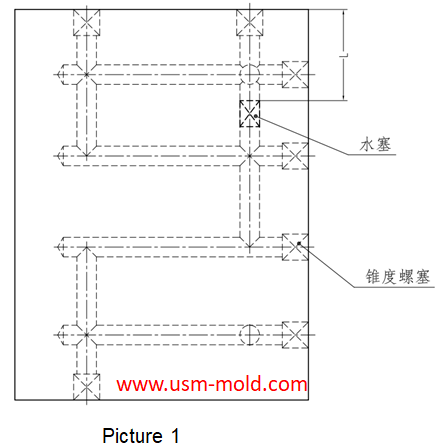
Plastic injection mold common cooling gate
1. Straight-through cooling water gate: the straight-through cooling gate is the most commonly used gate for plastic injection mold, and it is also the most convenient type of cooling for processing. It is commonly used on molds with thinner walls and larger areas, which shows in picture 1.
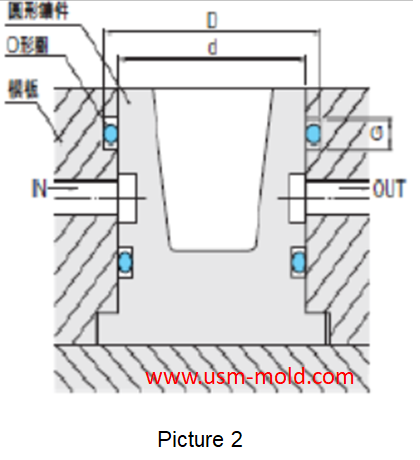
2. Annular cooling water gate: this cooling water gate is suitable for round inserts parts, where there is ejector pin and plastic material in the insert and cannot be used for cooling methods such as water well spraying, the common structure is shown in picture 2, we shold we should try to avoid the sealing ring being worn and worn by the cutting during assembly.
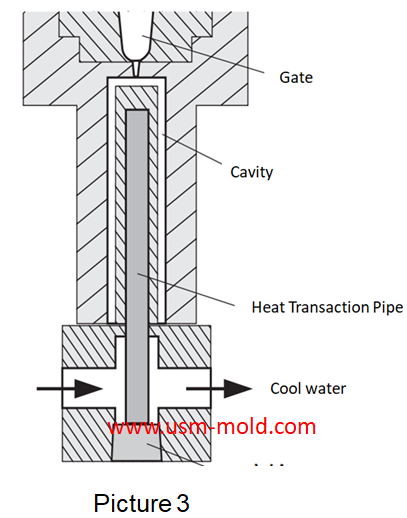
3. Heat conduction rod type: for some slight cores, conventional water transportation, spraying and water well cooling cannot be used, and heat conduction rods can be used to transfer the heat from the melt to the core, and then the cooling water carry out the heat from the mold, as shown in picture 3, the material of the thermal conductive rod is usually beryllium copper.
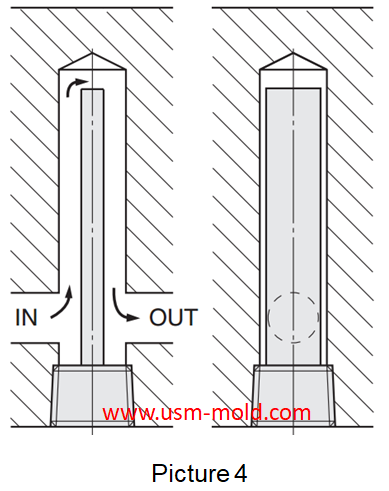
4. Baffle board cooling water gate: the baffle board is often used in deep cavity molds, this type of mold has a large core length and absorbs a lot of heat from the plastic melt, but the width or diameter is small and common, the cooling water gate is often unable to go up, and the ideal effect can be achieved by using a baffle board, as shown in picture 4.
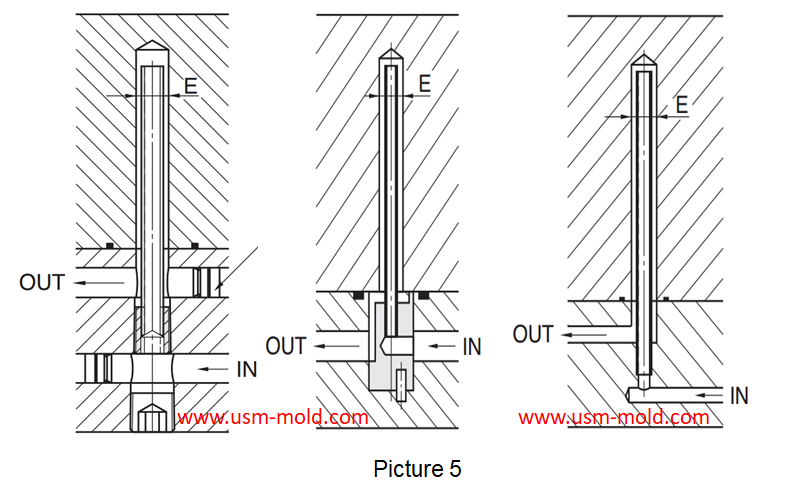
5. Cooling pipe type: the cooling pipe is the same as the baffle board for deep cavity molds, or places where the cooling water channel is difficult to reach but has a large amount of heat accumulation, this kind of cooling water gate needs to use a cooling pipe, it is not as pupular as baffle board in normal design, as shown in picture 5.
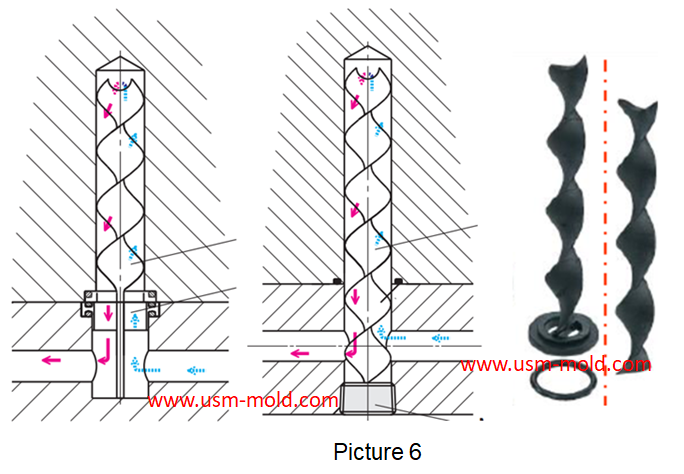
6. Spiaral baffle board: it is normally used as same cooling pipe and baffle board, but the cooling is better, it needs to add spiral pillar or spiral piece, as shown in picture 6.
Different treatment of plastic injection mold cooling system principles
Feb 22, 2022Different treatment principle: 1. The mold temperature is different according to the different plastics, when the plastic requires the molding temperature of the mold to be ≥80°C, the mold must be...view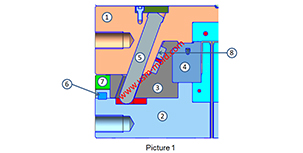
Slider of side core pulling mechanisum assembling
Jul 21, 2022The picture 1 shows a typical guide pin driven slider parting and core-pulling mechanism, we will talk about the composition and function of the lateral core-pulling mechanism. 1. Lateral forming...view
Plastic injection mold runner system design points
Jan 9, 2022When designing the gating system, Firstly, we should consider making the plastic melt fill the cavity with core side quickly to reduce pressure and heat loss; secondly, it should be economically...view
The design requirements of slider wear plate
Jan 2, 20241. The wear plate of slider requires hardening treatment, with a hardness of 45-48HRC; 2. The friction surface of the wear plate is required to be 1.0mm higher than the slider surface (see picture-1);...view
Insert pin of vengting design for molded parts
Mar 20, 2022Insert pin of venting: It is difficult to make exhaust slot when end runner is not in parting surface during injection, and there is no matching gap available, but we could make the venting pin at end...view
Five Major Steps of the Injection Mold Production Process
Dec 9, 2021Injection mold manufacturing can be roughly divided into the following steps: Process analysis of plastic products. Before the mold design, the designer should fully analyze and study whether the...view